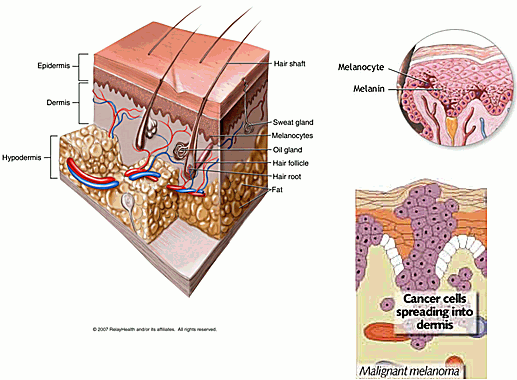
Melanoma is the most dangerous form of skin cancer. It is not the most common skin cancer, but it causes the most deaths. If recognized and treated early, it is nearly 100 percent curable. When not caught early, a melanoma spot the size of a dime can spread to other parts of the body where it becomes hard to treat.
Melanoma typically begins on the surface of the skin. It develops when melanocytes - the cells that give skin, hair, and eyes color - are damaged, which causes these cells to grow uncontrollably. Because melanoma develops where melanocytes occur, this cancer can begin on the skin, under a nail, and even in an eye or on a mucous membrane (mouth and genitals). It can grow deep into the skin and beyond. It can reach the blood and lymphatic vessels, and from there it can spread through the body, causing a life-threatening condition.
Melanoma is a skin cancer whose cause is not clearly understood. Half of all cases of melanoma occur in people under age 57. Statistically, men are more prone than women, and risk factors include family history of melanoma, history of multiple sunburns, age, light hair color, total number of moles present on the body, and location of the melanoma itself.[1] We also know that farmers who apply certain pesticides to farm fields are twice as likely to contract melanoma so there is a toxic chemical connection.[2]
The tanning industry labeled carcinogenic
 On an average day, more than 1 million Americans engage in indoor tanning.[3]
In 2009, the International Agency for Research on Cancer (IARC), part of the World Health Organization, reclassified tanning devices into the highest cancer risk category as “carcinogenic to humans.” Some say tanning beds are “the new cigarettes of our age.” The health care reform act passed in 2010 includes a 10% excise tax on indoor tanning services, akin to the “sin tax” on cigarettes.[4] The industry faces new, stricter regulations, and there is talk of class action suits.
The Melanoma Research Foundation reports that tanning bed use among people under the age of 30 can increase the risk of developing melanoma by up to 75 percent.[5]
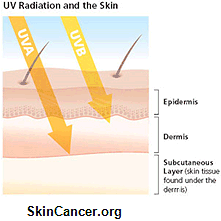 The problem may have been aggravated by design. Sunlamps and sunbeds have generally designed to produce more UVA than UVB based on the conventional wisdom that UVB was more carcinogenic than UVA. This belief came from studies of squamous cell carcinoma in albino hairless mice which are now thought to have been misleading.[6] UVA penetrates the skin more deeply than UVB. The high-pressure sunlamps used in tanning salons emit doses of UVA as much as 12 times that of the sun.[7]
Blame it on the sun?
The basic facts don’t add up that simple sun exposure leads to melanoma:
 In 1900, about 75% of the U.S. population worked outdoors. Melanoma was rare. But since the 1970s, the incidence of melanoma has been steadily rising. It is rising at a time when sun exposure is decreasing, when vitamin D deficiencies are becoming epidemic.
- Melanoma is more common in indoor workers than outdoor. It is not a disease of farmers; it is a disease of office workers.
- Melanoma is more common on regions of the body that are not exposed to the sun.
- It was not until about 1990 that professional opinion began to suggest that melanoma was caused by exposure to the sun. A meta-analysis reported in 2005 found that studies undertaken before 1990 generally found no association between sun exposure and melanoma, but later studies did find an association. The research team suggests that these later studies were influenced by biased recall of participants who knew from wide publicity that experts believed skin cancer was caused by sun exposure.[8]
- Melanoma is the second leading cause of cancer death for people age 15 to 30, and the rate is increasing.[9]
A number of people connect these dots and come up with an important factor that has drastically changed since 1970, one that would also account for melanoma striking younger people: diet. Dr. John Cannell of the Vitamin D Council:
“Diets rich in vegetables, fruits, and omega-3 fats - the absence of appreciable quantities of omega-6 and trans-fats - protects your skin from burning. The people who get sunburned are modern humans who live and work indoors, avoid fruit and vegetables, love french fries and chips, hate salmon, and go to the beach two or three times in the summer to roast themselves. Frequent sunburns, especially in childhood, are but one factor in melanoma - genetics and diet are more important.[10]
Other people connecting the dots look to the atmosphere. Conventional wisdom says the thinner the ozone layer, the more those burning UVB rays reach us. So as we have less protection from ultraviolet light, we are more at risk for skin cancers - a diminishing ozone layer is a threat to the human race.[11]
Groundbreaking work from the research team at the University of California-San Diego says it is not that simple and is turning conventional wisdom on its head. Researchers found that:
- Countries with persistently high percentage of cloud cover had significantly higher incidence rates of breast and colon cancer.[12]
- The thicker the ozone layer, the higher the rates of melanoma. Australia and New Zealand, for example, have a very thick ozone layer, and they have very high rates of melanoma.[13]
In both cases they say, the atmospheric condition acts as a sunscreen, blocking the body’s ability to make vitamin D. No UVB reaching ground level means no protective vitamin D. So just as we overturned our early 1980s thinking that there was no vitamin D deficiency in America, we are being asked to rethink that UVB is all bad, that being outdoors the very hours we are warned not to be – 10 AM to Noon – is exactly when we need to be exposed to make D.
The UCSD researchers also make a compelling argument that when sunscreens morphed from being potions to promote a tan to potions to block the sun, the rates of melanoma and other cancers went up. The ability to tan is a highly protective factor, and sunscreens inhibit this natural protection. Until just recently, sunscreens blocked just UVB, not UVA which is much more prevalent in the sun’s rays. As sun block products got stronger SPF ratings, melanoma rates went up. Coincidence? Or the result of knocking out the UVB that produces cancer-protective vitamin D? One thing we do know - there are no studies showing that sunscreens prevent melanoma.
These new concepts challenge cancer organizations around the world to change their thinking. As members of the UCSD research team wrote:
“The idea that UVB irradiance and vitamin D might save thousands of lives would require not only backing away from the idea that any sunlight was risky, but replacement of the accepted paradigm that colon and breast cancers were due to too little fibre, too much fat, and, possibly, a few bad genes. These were entrenched paradigms.
“Vitamin D comes from two sources, diet and solar radiation. This is unique, and is one reason why the association was not immediately obvious. Either could mask the other, making it hard to recognize vitamin D’s importance. Another reason that the role of vitamin D deficiency had gone unrecognized was that it was broadly accepted that there was no vitamin D deficiency in the U.S.
“There is excitement regarding a role of vitamin D as part of cancer therapy. Cancer patients who live in places with high solar UVB radiation have better survival rates than those in areas deprived of solar UVB radiation, and patients whose cancers are treated during the summer months also have better survival rates.[14]
Meanwhile, dermatologists still push sunscreen. A notable exception is Dr. Arthur Rhodes, board certified in dermatology, at Chicago’s Rush University Medical Center. In 2006 he warned:
“Unfortunately, as a result of public messages that emphasize the role of ultraviolet radiation (UVR) exposure in tumor development, most general physicians and lay people believe that most if not all cases of CM are the direct result of UVR exposure.
In fact, we do not know the case fraction of CM [melanoma that starts in the skin, rather than the eye or an internal organ] directly attributable to UVR and the unintended consequences of current messages directly linking UVR exposure and CM development may be thwarting the primary intervention goal of reducing tumor-related mortality.”[15]
Can excessive sun exposure and repeated sunburns cause melanoma? Everyone says yes. However, an appropriate amount of sunshine actually prevents cancers by creating vitamin D and that is a message that needs more exposure. Balance is the holy grail of health.
Blame it on the electronic airways?
Some experts looked at the expanding communication technology in the last several decades and found a striking association between the increase in certain cancers, including melanoma, and point to the ever-increasing electronic bombardment by radio and TV signals.
The first to raise the issue were researchers Dr. Olle Johansson and colleague Örjan Hallberg at the Karolinska Institute in Sweden. They found a strong association between the increase in certain cancers during the 20th Century and exposure to electromagnetic fields as measured by radio and TV broadcasts. They reported that there is a common environmental stress that accelerates several forms of cancer - colon cancer, lung cancer, breast cancer, bladder cancer, and melanoma. They site the introduction of AM radio (1920s), radar (1940s), FM radio and TV (1950s), computers (1970s), mobile phones (1980s), and wireless technologies and compact fluorescent lighting (2000s), and conclude that artificially created EMR is the most likely environmental stress to account for the rise in cancers.[16,17,18]
We know that our brains, hearts, and cells use electromagnetic signals - we measure the electrical output of the heart for example with an EKG. Much study is underway to determine exactly how the body’s electrical signalling can be interfered with by external electromagnetic fields. The 2004 Reflex study out of Europe determined that radio waves from mobile phones harm body cells and damage DNA in laboratory conditions.[19]
What exactly is melanoma?
Melanoma arises from a type of cell called melanocyte, present in the deep in the epidermis, the top layer of the skin.
As a fetus forms, melanocytes migrate from a nest of cells that will make up the body’s nervous system. They go on to form both skin and eyes, so in a very real sense, they are part of the body’s neurologic system. Melanocyte stimulating hormone (MSH) is produced by the pituitary gland, and is part of the same family of hormones as adrenocorticotropic hormone, the hormone which stimulates the adrenal glands to enable us to deal with stressful situations.
Melanin, the hormone produced in response to MSH, is a free radical scavenger, but it can also produce free radicals which damage DNA. It would appear to be an energy transducer, able to transform different energies into heat or other useful forms of energy.[20]
Checking the alphabet for melanoma
How do you look for melanoma? Follow the alphabet device.
is for asymmetry. Most moles are quite symmetrical. Melanomas tend to have lumps and bumps.
is for border. The edges of a melanoma tend to be uneven.
is for color. Benign moles tend to be all the same color. If you see several different colors within the same mole, be suspicious that it is a melanoma.
is for diameter. Most benign moles are less than 6 mm in diameter (about 1/4″, the size of a pencil eraser). If the mole is larger, be suspicious.
is for evolving. Is it getting larger? Changing color or shape? Be suspicious.
Staging melanoma
Melanomas come in several different types -
• superficial spreading (the most common)
• nodular (lumpy, grows deep)
• lentigo malignant (flat large lesions)
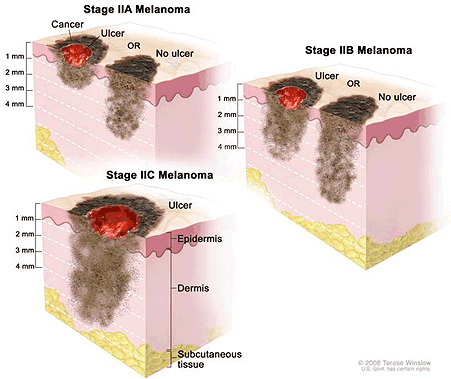
• acral lentiginous (on the palms of hands, soles of feet, and under fingernails)During the initial growth phase, melanoma spreads out horizontally, above the basal lamina of the skin. Later, it dives deep to the basal lamina, and still later it can spread to regional lymph nodes and even to other parts of the body. These various stages of melanoma development are called Clark stages, and they are used to give you an idea of probable outcome of the disease.
Level 1 - very superficial, in epidermis only
Level 2 - a little deeper, into the superficial layers of the dermis
Level 3 - deeper yet, to the interface between superficial dermis and deeper reticular dermis
Level 4 - still deeper, into the reticular dermis
Level 5 - into the subcutaneous tissues.
Staging of melanoma is useful in terms of prognosis (prediction about how the disease will manifest in your body). Remember that prognosis depends not only on the appearance and growth characteristics of the tumor, but also on the health of the host, i.e. YOU.
Stage 0 Very superficial, very little danger of spread as long as the tumor is removed surgically. Stage 1 Tumor less than 1 mm thick, no skin breaks. Stage 2 Tumor less than 4 mm thick, may or may not have ulceration at the surface, The tumor has already penetrated the dermis, and thus is at least a Clark level 2, but may be as much as a Clark level 5. Stage 3 Tumor of any size, spread to any number of lymph nodes. Stage 4 Tumor is metastatic, appears in other areas of the body in addition to the primary tumor. How to deal with melanoma
Standard therapy for melanoma is surgical, by complete excision of the lesion, hoping to get clean margins. In other words, a lot of tissue is cut out in the hope that the melanoma can be completely removed. Melanoma is notorious for reoccurrence at the site of the original lesion. When the lesion is on the back, this is not really a problem. When it’s on the nose, that is more of a problem.
For any lesion larger than 1 mm (about 1/16″ inch), sentinel node mapping is recommended. Radioactive tracer is injected into the area around the melanoma, to determine where the tracer collects in the first lymph nodes to drain from the tumor location - these are the most likely nodes to harbor any tumor cells if the tumor has begun to spread or metastasize. These nodes will be removed surgically and examined by the pathologist.
Surgery is not enough to control melanoma once it spreads to other parts of the body.
A new experimental drug - a monoclonal antibody - is reported to improve survival, according to a study of 676 melanoma patients published in the New England Journal of Medicine in 2010. Patients with advanced melanoma who received the drug, called ipilimumab, lived an average four months longer than those treated with a cancer vaccine. However, 15 percent of the patients suffered side effects, and 14 patients died. Tampering with the normal immune system is bound to have consequences, and predictably the chief side effects of this immune system altering drug are immune response effects - diarrhea, rashes, and terrible itching - treated with steroids, which have their own set of side effects. The study was funded by Bristol-Myers Squibb, which also makes the drug.[21]
More promising is a 2010 study of tumor cell genetics showing that there is some variability of genetic expression in the tumor cells. The study questioned whether this might not be a useful way of determining chemosensitivity.[22] In other words, let’s custom design the chemotherapy to attack just the cancer cells, leaving alone the healthy cells. That is not some futuristic possibility. We do that all the time at the Arizona Center for Advanced Medicine.
We analyze your blood for circulating tumor cells. Their characteristics are measured for “chemosensitivity,” meaning we determine how their unique genetic makeup will respond to drugs and natural therapies. The test tells us which drugs and which natural agents will help defeat your cancer as well as nurture your immune system. With this determination, we devise a custom treatment plan based on the chemosensitivity of your circulating tumor cells. We use Insulin Potentiation Low Dose Chemotherapy, a modified form of chemotherapy that targets a small amount of drugs to the cancer cells, saving wear and tear on healthy cells. In this way, we avoid the nasty side effects which are universal with standard high dose chemotherapy treatments.
[1] Cho E, Rosner, B et al. Risk Factors for Melanoma by Body Site. Cancer Epidemiology, Biomarkers & Prevention May 2005 14; 1241. [2] Leslie K. Dennis, Charles F. Lynch, et al; Pesticide Use and Cutaneous Melanoma in Pesticide Applicators, Environmental Health Perspectives, June 2010. 118(6): doi:10.1289/ehp.0901518. [3] http://lawblog.legalmatch.com/2010/06/11/tanning-beds-and-legal-liability [4] http://www.upi.com/Health_News/2010/03/23/Reforms-tanning-bed-tax-may-save-lives/UPI-40121269402695 [5] http://www.24-7pressrelease.com/press-release/melanoma-research-foundations-statement-on-fda-regulation-of-tanning-beds-143649.php [6] Moan, J.,Dahlback, A., Setlow, R., Epidemiological support for an hypothesis for melanoma induction indicating a role for UVA radiation. Photochem. Photobiol., 1999. [7] http://www.skincancer.org/understanding-uva-and-uvb.html [8] Gandini, S., et al., Meta-analysis of risk factors for cutaneous melanoma: II Sun exposure. European Journal of Cancer, 2005. [9] Melanoma Research Foundation [10] Dr. J Cannell, The Vitamin D Newsletter, August 2006 [11] EPA factsheet, Ozone Science: The Facts Behind the Phaseout Accessed June, 2010 [12] S Mohr, C Garland, et al; Mapping Vitamin D Deficiency, Breast Cancer, and Colorectal Cancer. 2005 ESRI User Conference paper. [13] E Gorham, Frank Garland, et al; Does UVB absorption of ultraviolet by stratospheric ozone and urban aerosols influence colon and breast cancer mortality rates? Contributions from NASA and NOAA data. Proc. SPIE, Vol. 5886, 58860Q (2005); doi:10.1117/12.616272 [14] Cedric F Garland, Frank C Garland. Commentary: Progress of a paradigm. International Journal of Epidemiology, 2006 35(2):220-222; doi:10.1093/ije/dyi230 [15] Dr. A Rhodes, Cutaneous melanoma and intervention strategies to reduce tumor-related mortality: what we know, what we don’t know, and what we think we know that isn’t so. Dermatol Ther. 2006 Jan-Feb;19(1):50-69. [16] Hallberg, Örjan and Olle Johansson. Cancer Trends During the 20th Century.Journal of the Autralasian College of Nutrition and Envrionmental Medicine. 2002a. 21(1): 3-8 [17] Hallberg, Örjan and Olle Johansson. Melanoma Incidence and Frequency Modulation (Fm) Broadcasting. Archives of Environmental Health. 2002b. 57(1): 32-40 [18] Hallberg, Örjan and Olle Johansson. Fm Broadcasting Exposure Time and Malignant Melanoma Incidence. Electromagnetic Biology and Medicine. 2005. 24: 1-8. [19] http://www.worldhealth.net/news/mobile_phone_radiation_harms_dna_new_stu [20] Hill HZ. The function of melanin or six blind people examine an elephant. BioEssays 14;1:49-56. [21] http://www.medscape.com/viewarticle/723052 [22] Vásquez-Moctezuma I, Meraz-Ríos MA et al. ATP-binding cassette transporter ABCB5 gene is expressed with variability in malignant melanoma. Actas Dermosifiliogr. 2010 May;101(4):341-8.Melanoma Skin Cancer